THE YORKSHIRE DALES GREEN LANES ALLIANCECampaigning to free green lanes from recreational vehicles. Where the tarmac stops, vehicles should stop. YDGLA, PO Box 159, Otley, LS21 9BTEmail: ydgla@europe.com
Home |
Solutions |
How the YDGLA campaigns
The Area and its Problems
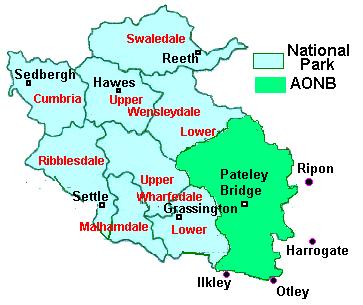
The Dales National park and the Nidderdale Area of Outstanding Natural Beauty (AONB) THE PROBLEM (See the Glossary page for fuller explanations of the terms used below.) Nobody knows precisely how many green lanes in the Dales are legally open to motor vehicles. This may seem strange, but English highway law is obscure and intractable. When national parks were founded, back in 1949, it was envisaged that the network of green lanes, which until then had carried chiefly local, agricultural vehicular traffic, would sink gently back into the landscape and would be used only by farmers, cyclists, horse-riders and pedestrians. Highway authorities were expected to concentrate their efforts on maintaining the tarmacadamed motor roads, and to apply to the unsealed green lanes only the minimal maintenance necessary for the classes of users that were envisaged. However - and this is where a great opportunity to protect the countryside was missed - vehicular rights on the green lanes were never formally extinguished. So, with the advent of modern recreational motor vehicles 4x4s and motorbikes built to cross rough country - the network of green lanes became vulnerable to claims that, because the lanes were once open to horses and carts, they are still legally open to convoys of 4x4s and motor-bikes, even though most of the tracks themselves are still in pretty much the state they were in when the only wheeled traffic was pulled along by a horse. The Natural Environments and Rural Communities Act (NERC) 2006, goes a long way toward ending the archaic rule that said that if a horse and cart, centuries ago, legally used a route, 4x4s and motorbikes can use it now, no matter what the character of the route. But the NERC Act does not solve the problem completely. There are still miles and miles of green lanes that are still vulnerable to motors. There is still plenty of work for YDGLA to do. Just how many green lanes in the Dales will eventually have to be recognised as bearing rights for motor vehicles is unclear. One set of green lanes, known as ‘Byways Open To All Traffic’ (BOATs) certainly do bear rights for motor vehicles of all types. There are approximately 31 kms of BOATs in the Dales National Park, and a few in the Nidderdale AONB. More BOATs may have to be created if recreational vehicle users’ applications that escaped the NERC Act are successful. A second, much more extensive set of green lanes, known as ‘Unsurfaced Unclassified County Roads’ (UUCRs) may, or may not, bear vehicular rights. There are hundreds of kilometres of UUCRs in the Dales. The precise rights-of-way status of UUCRs is unclear - that is why they are called ‘unclassified’ - and until the status of each of the routes is established, case by case - a process that will take years - , vehicle user groups will insist that they are entitled to use all of them. Without waiting for the determination of the rights on UUCRs, 4x4 and motorbike users go right ahead and drive and ride along them. In determining the precise rights-of-way status of any particular green lane, the authorities may not take into account the lane’s beauty, its capacity to withstand the passage of motor vehicles, its tranquillity, or the amenity it offers non-motorised users.All that counts is whether, once upon a time, it was legally open to horses and carts.If it was, then it must now be acknowledged as being open to motor vehicles. The problem of illegal vehicular use is intractable too. The uncertainty of the legal status of many routes, coupled with the difficulties of police enforcement, gives many recreational vehicle users the confidence to go pretty much where they please: some vehicle users will nose down any inviting track, or will traverse the high fells, well away from any track at all. In some areas (Blubberhouses Moor is a good example) large areas of open moorland were turned into what looked like moto-cross circuits, stripped bare of vegetation by the repeated passage, round and round, of motorbikes. And wherever a steep and challenging hillside adjoins a track, many vehicle users will leave the track in search of the thrills that steep gradients give them. The authorities have had to place huge boulders or fences alongside some routes to dissuade vehicle users to stay on the right of way. 4x4 and motorbike use of green lanes is not a minor, fringe activity, restricted to just a few enthusiasts, using just a tiny handful of routes, on low-powered machines. On one day in 2002, for example, over a hundred motorcycles were counted on the green lane that descends from Deadman’s Hill, into Coverdale, from Nidderdale. It is not unusual to see vans or trailers parked at the roadside with motor-bikes, used expressly for cross-country riding, being unloaded and ridden off into the hills. And because the fell-sides in the Dales are predominantly tree-less, the noise of off-road vehicles echoes literally for miles, disturbing the peace and tranquillity that the National Park and the AONB were set up to preserve. The damage to the tracks themselves, as anyone who has seen the green lanes at first hand will know, is shameful. The NERC Act may have brought a reduction in the numbers of 4x4s and motorbikes in the Dales, but there are still plenty of motor-cyclists and 4x4 users whose only idea of a good day out in the Dales is to ride and drive their vehicles along green lanes. Some examples of the problem:
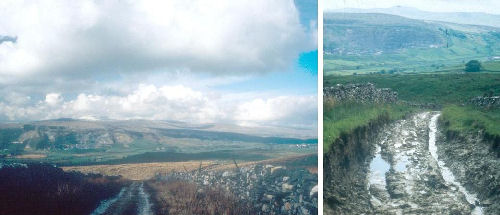
These photos were taken from exactly the same spot in Ribblesdale, ten years apart (1989 and 1999). Agricultural use of this lane has remained constant during this decade. The number of off-road vehicles has sharply risen. The consequence is plain: in some places the surface of the track has been cut down more than a metre below the 1989 level.
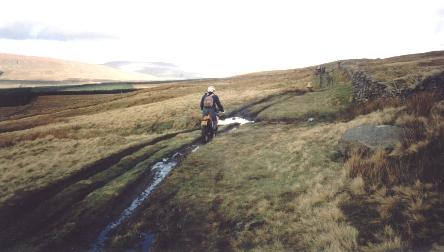
Motorcycles in Dentdale.
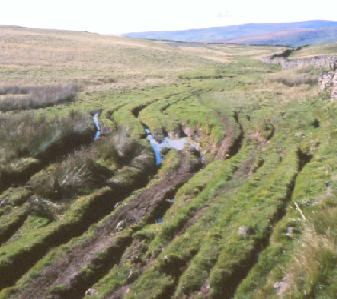
Gorbeck Road is a typical example of what has been happening to green lanes in the Dales. Gorbeck is a fine route, connecting Ribblesdale to Malhamdale.It has historically never been surfaced along its central moorland section and is, as the photograph shows, entirely unsuitable for motor traffic. Agricultural vehicles rarely use the route. Yet at a public enquiry, the inspector’s conclusion was that enclosure awards from the late 18th and early 19th centuries show that the route was indeed open to horses and carts, and that, consequently, the route must now be acknowledged to be open to modern motor traffic.This was particularly unfortunate, for the route was chosen to become part of the ‘Settle Loop’ of the Pennine Bridleway. The Park Authority spent a great deal of money in bringing the route up to the standard necessary for the passage of horses and mountain bikes. Furthermore, using the powers conferred on it by the NERC Act, the Authority imposed a traffic regulation order on the route, prohibiting recreational vehicles. This order not only protected the fabric of the route from damage by vehicles: it guaranteed the peace and tranquillity that is one of the Park’s most-prized special qualities, and which is jeopardized by the presence of motorbikes and 4x4s. The order was welcomed by the general public, but in July 2009 the vehicle users’ organization, LARA, succeeded in getting the order quashed in the High Court, on a legal technicality. At once, vehicle users returned to the route and made a mess of it. The Park Authority responded by taking into account the judge’s strictures, and re-running its assessment of the route. The result is that a secure, unchallengeable traffic regulation order, prohibiting recreational vehicles is now in place. The route now looks much better than it did when the above photo was taken. Gorbeck Road is now safe from all recreational vehicle users, save those who deliberately and flagrantly break the law. (See Latest News for the full story of Gorbeck Road.) |